.png?width=60&height=60&name=%E3%83%AD%E3%82%B4_%E7%99%BD%C3%97%E9%BB%92300%20(1).png)
Siteimprove
Is your website accessible
to every user?
Webサイト品質と
アクセシビリティ向上に
必須プラットフォーム
Is Your Website Ready for the Accessibility Shift?
Improving web quality and accessibility is no longer just about meeting global regulatory standards—it is a critical requirement for protecting your brand equity and deepening user engagement. Siteimprove is here to help you take that essential first step.
Why Accessibility? Why Now?
The business impact of legislative change
Under Japan's amended disability discrimination law, businesses must provide reasonable accommodation when requested by a person with a disability — unless doing so constitutes an undue burden. While web accessibility is not yet mandated in every specific instance, it is increasingly central to what 'reasonable accommodation' means in a digital context.
Early adoption gives companies a meaningful head start: reduced legal risk, stronger brand trust, and a digital presence that works for everyone from day one.

The scale of the opportunity
Over 29% of Japan's population is currently aged 65 or older, with that figure expected to reach 35% in the coming decade. Vision loss, hearing impairment, and reduced motor function all affect how users interact with digital content. A UI that is 'hard to see' or 'hard to navigate' for older users is a lost visitor — and often a lost customer.
The WHO estimates that 16% of the global population lives with some form of disability. For a high-traffic website, that figure represents millions of users who may be unable to access your content, complete a transaction, or contact your team.
✖️ The Cost of Poor
Accessibility
- Visual Barriers: Low contrast ratios make your content unreadable for many, leading to immediate site exits.
- Interaction Fatigue: Small touch targets frustrate mobile users and limit physical reach.
- Context Gaps: Vague labels create "interface anxiety," making users hesitant to click.
☑️ Design That Scales for Everyone
- Precision Contrast: We exceed WCAG standards ($4.5:1$ or $7:1$ ratios) to ensure your message is crystal clear in any lighting or condition.
- Touch-First Engineering: Large, ergonomic hit areas ensure a seamless experience across desktop, tablet, and mobile.
- Semantic Clarity: Descriptive, human-readable labels ensure your interface is understood by every user and all assistive technologies.
What is web accessibility?
Web accessibility means ensuring that information, functions, and services on your website can be used by all people, across all devices, regardless of ability or circumstance. In practice, this includes:
- Colour contrast ratios that meet WCAG standards (minimum 4.5:1 for body text), so content is readable for users with colour vision deficiencies
- Heading structures and HTML semantics compatible with screen readers and assistive technologies
- Keyboard navigation support for users who cannot use a mouse or touchscreen
- Alt text, captions, and transcripts for non-text content
Japanese and international
standards
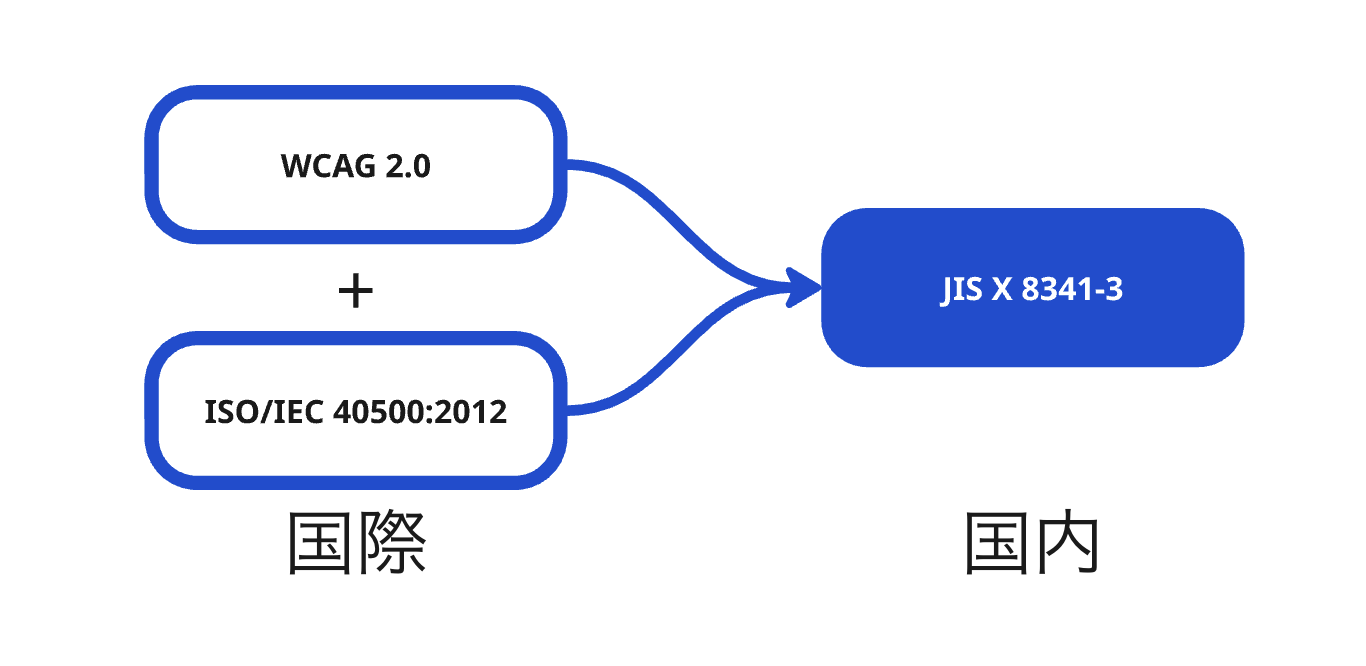
Japan's web accessibility standard, JIS X 8341-3, was technically aligned with ISO/IEC 40500:2012 (WCAG 2.0) following its 2016 revision. This means domestic JIS compliance, international ISO compliance, and W3C WCAG compliance are now largely consistent — allowing companies to implement a single accessibility strategy that satisfies both Japanese and global requirements.
Sustained accessibility is not achieved through a one-time audit. It requires a structured PDCA cycle embedded in your content and development operations:
- Plan: Define your accessibility policy, scope, and targets — and publish them for internal and external stakeholders.
- Do: Design and develop content that meets WCAG and JIS X 8341-3 guidelines from the start, not as a retrofit.
- Check: Test continuously, publish results, and identify gaps before they become compliance incidents.
- Act: Update content and workflows based on test outcomes, and adapt as standards evolve.
Request a free accessibility audit and see exactly where your digital presence stands against WCAG and JIS X 8341-3 requirements — with a prioritised list of improvements and a clear view of the business impact.
Underworks is also hosting a practical webinar in June covering the latest steps in accessibility compliance for Japanese enterprises. Contact us to join the invitation list.